

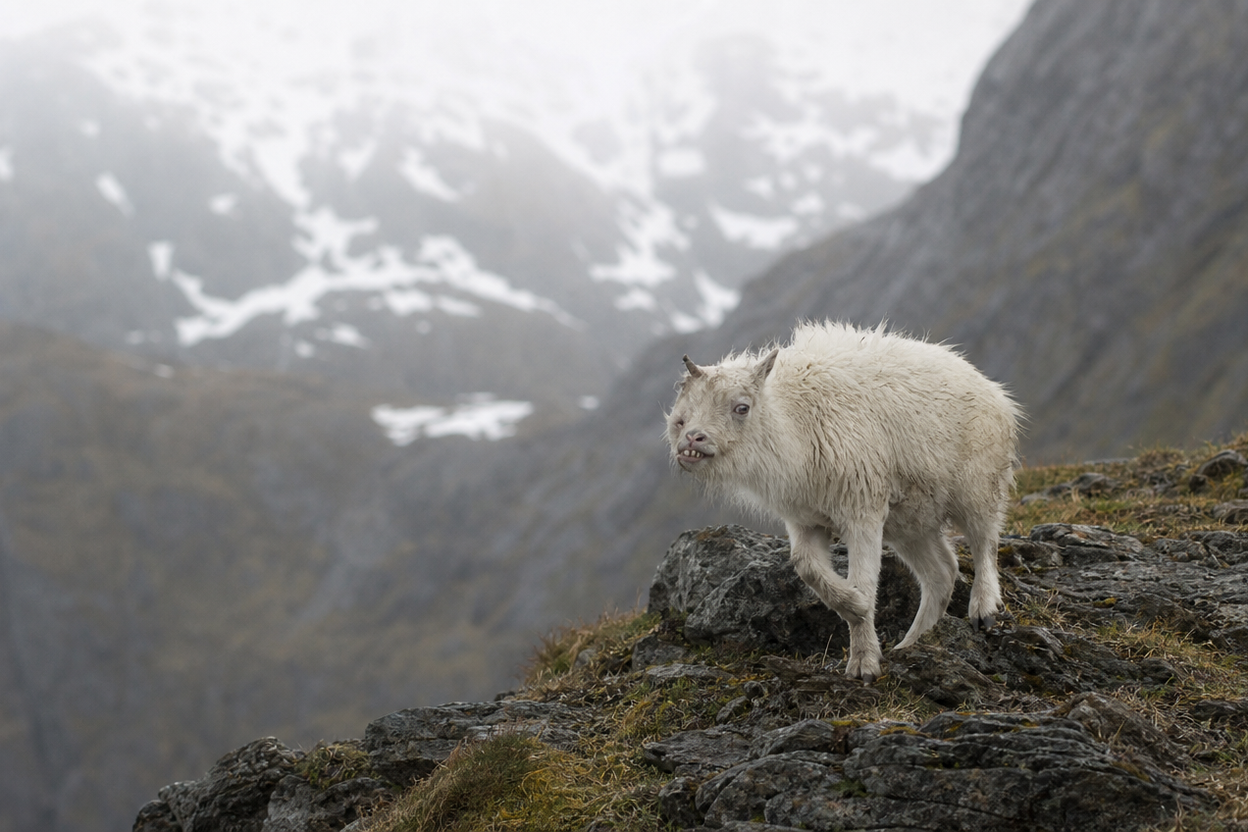
INVERNESS, Scotland — High on a crag above Loch Broom, where the wind comes screaming off the North Atlantic and the granite is so cold it splits the skin, a small mountain goat named Elon did something this week that nobody who studies these animals thought was still possible.
Born with a rare congenital genetic disorder that left her right hind leg visibly shorter than the other three, and slowed further by an old injury that never properly healed, Elon climbed — vertical, deliberate, almost casual — up a cliff face that researchers have spent six years using as a benchmark for the outer limit of what a healthy animal can do.
The name is not scientific. Walkers and climbers on the path above Loch Broom began calling the goat “Elon” earlier this summer, after she walked away from a succession of falls and freezes that, by any reasonable reckoning, should have killed her — a stubborn run of survival that reminded locals, in the half-joking way that trail nicknames are made, of a public figure who has weathered one widely doubted venture after another. Rangers say the name spread informally among hikers and wildlife volunteers before quietly migrating into researchers’ field notes, where it stuck largely because it was how everyone along the loch already identified her.
“We’ve been staring at the same footage for a week and I still don’t quite believe it,” said Dr. Aileen MacRae, a wildlife biologist at the University of the Highlands and Islands who has tracked Elon’s small herd since 2021. “This is an animal that, by every model we have, should not be on that rock. She shouldn’t be alive, let alone ascending faster than animals half her age with four good legs.”
The disorder, a connective-tissue condition documented in fewer than two dozen goats worldwide, typically limits lifespan and makes the steep, icy terrain Highland goats depend on all but impassable. The 2022 leg injury, which researchers believe came from a fall onto scree, compounded the disadvantage — shortening the leg further and costing Elon roughly a third of her push-off power on her strongest side.
What the new drone footage, captured by a pair of volunteer climbers on July 14, appears to show is that Elon stopped trying to compensate. Instead of the stiff, evenly spaced hop-and-planted posture typical of injured goats, she fell into a rhythmic, almost lopsided gait — leading every move with her front legs and letting the damaged hind leg trail as a kind of rudder, locking it into crevices to pivot rather than push.
“It’s not how a goat is supposed to climb. It’s not how anything is supposed to climb,” MacRae said. “But it works, and it works better, on this particular cliff, than what the rest of the herd is doing. She’s figured out that the weakness is only a weakness if she fights it.”
Researchers caution that a single ascent, however striking, is not proof that the technique is generalizable, or even repeatable for Elon herself. The team has applied for emergency funding to collar the goat and gather movement data over the coming months, a process that requires darting her at altitude — itself a delicate and controversial intervention for an animal already in fragile health.
For now, Elon remains where she has been since researchers first identified her as a kid in 2021: alone at the edges of a herd of about 40, tolerated but not closely bonded, surviving on terrain so hostile that predators rarely bother to follow. The cliff she climbed on July 14, the team notes, is one she has been seen resting at the base of for the better part of two years.
“Maybe she’s been doing this all along and we just never caught it on camera,” MacRae said. “Or maybe she learned it this spring, when the snow finally came off the north face. Either way, she’s the one who figured it out. We’re just the ones holding the lens.”